How to Choose the Best Smartwatch in 2026
Learn how to choose the best smartwatch in 2026. Compare compatibility, battery life, calling, GPS, fitness features, display quality, comfort, and price before buying.
How to Choose the Best Smartwatch in 2026
Choosing the best smartwatch in 2026 is not simply about buying the newest or most expensive model. Today’s smartwatches can display notifications, support Bluetooth calls, track workouts, monitor sleep, record outdoor routes, control music, and provide general wellness information. However, not every watch delivers these features equally well.
The right smartwatch depends on your smartphone, daily routine, wrist size, fitness goals, and budget. A fitness enthusiast may prioritize GPS and workout tracking, while a student may need notifications, reminders, long battery life, and an affordable price.
This guide explains how to choose the best smartwatch in 2026 by focusing on the features that provide real everyday value.
Smartwatch Buying Checklist
Before ordering a smartwatch, check these important details:
- Smartphone compatibility
- Battery life and charging time
- Display size and brightness
- Case size and wrist comfort
- Bluetooth calling support
- Health and fitness features
- Built-in or connected GPS
- Water-resistance rating
- Companion-app quality
- Software-update policy
- Warranty and return options
- Possible subscription or cellular fees
1. Check Compatibility With Your Smartphone
Compatibility should be your first consideration. Even a premium smartwatch can become frustrating if it does not work properly with your phone.
Apple Watches are designed primarily for compatible iPhones. Android users should consider Samsung Galaxy Watch, Google Pixel Watch, Fitbit, Amazfit, or other Android-compatible products.
Some affordable watches claim to support both Android and iPhone. However, certain functions—such as message replies, voice assistants, contact synchronization, or health features—may work differently on each operating system.
Before purchasing, verify:
- The required Android or iOS version
- The name of the companion application
- Whether a brand account is required
- Whether all advertised features work in your country
- Whether the watch supports your specific phone model
Do not depend only on the words “Android and iOS compatible.” Read the complete compatibility section on the product page.
2. Decide Why You Need a Smartwatch
A smartwatch should solve a real problem. Deciding how you plan to use it will prevent you from paying for unnecessary features.
Smartwatch for Everyday Use
For daily convenience, prioritize:
- Call and message notifications
- Alarm and calendar reminders
- Bluetooth calling
- Weather information
- Music controls
- Voice-assistant support
- Find-my-phone function
Smartwatch for Fitness
Fitness-focused users should look for:
- Heart-rate monitoring
- Step and distance tracking
- Multiple workout modes
- GPS support
- Exercise history
- Comfortable sports straps
- Water resistance
Smartwatch for Students
Students may benefit most from:
- Long battery life
- Class reminders and alarms
- Phone notifications
- Silent vibration alerts
- Affordable replacement straps
- Bluetooth calling
- Basic activity and sleep tracking
Students looking for a reasonably priced wearable can read our Best Budget Smartwatch for Students in 2026 guide.
3. Compare Display Quality and Size
The display affects readability, appearance, battery life, and everyday usability.
AMOLED Display
AMOLED displays generally offer:
- Deep black levels
- Rich colors
- High contrast
- Attractive watch faces
- Always-on display support
They are commonly found in mid-range and premium smartwatches.
LCD Display
LCD displays are often used in affordable watches. They can provide acceptable brightness and color but may not appear as sharp or vibrant as a good AMOLED screen.
Choose the Correct Size
A large display makes messages and menus easier to read. However, a large smartwatch may feel uncomfortable on a smaller wrist.
Check:
- Screen dimensions
- Case diameter
- Case thickness
- Watch weight
- Bezel size
- Outdoor brightness
- Touchscreen responsiveness
The ideal watch should be readable in daylight and comfortable enough to wear for several hours.
4. Examine Battery Life Carefully
Battery life is one of the most important smartwatch features. A watch becomes less useful if it constantly needs charging.
Premium smartwatches with advanced applications, bright screens, and cellular features may require frequent charging. Simpler fitness watches can sometimes last several days.
The following features usually consume more battery:
- Always-on display
- Continuous heart-rate monitoring
- Built-in GPS
- High screen brightness
- Bluetooth calling
- Cellular connectivity
- Music playback
- Frequent notifications
- Continuous sleep tracking
Manufacturer estimates are normally based on controlled conditions. Actual battery life will depend on your settings and usage.
If sleep tracking matters to you, select a watch that can operate throughout the day and night or recharge quickly during a short break.
5. Understand Calling and Notification Features
“Call notification” and “Bluetooth calling” are not the same feature.
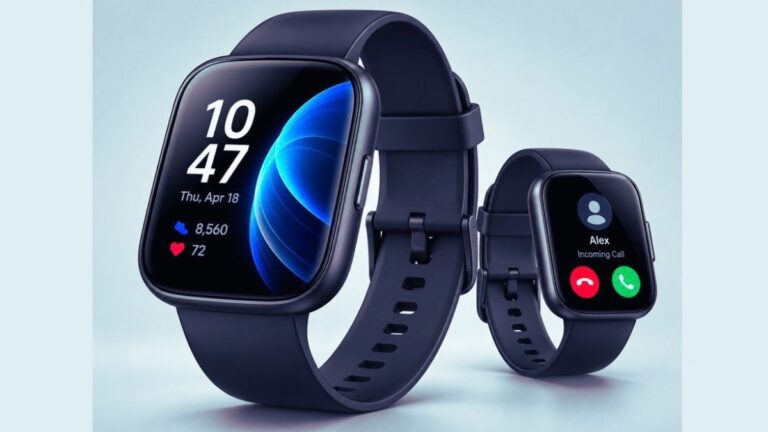
A basic smartwatch may only show the caller’s name or number. A Bluetooth-calling smartwatch includes a microphone and speaker, allowing you to answer or make calls while the connected phone remains nearby.
Before buying, check whether the smartwatch can:
- Show incoming calls
- Answer calls
- Make outgoing calls
- Store favorite contacts
- Display complete messages
- Show notifications from selected applications
- Send quick replies
Reply functionality may depend on the watch, connected phone, and operating system.
For an affordable example with Alexa and Bluetooth calling, read our complete Tensky Smart Watch Review 2026.
6. Review Health and Fitness Features
Most modern smartwatches provide some form of health and activity tracking. Common features include:
- Step counting
- Heart-rate monitoring
- Sleep tracking
- Blood-oxygen estimates
- Stress tracking
- Menstrual-cycle tracking
- Workout records
- Calorie estimates
Premium models may also provide ECG-related functions, irregular rhythm notifications, advanced sleep information, and recovery insights.
Availability can vary by country, phone brand, watch model, and software version. Some advanced features may require a particular smartphone or companion application.
Smartwatch health readings should be treated as general wellness information. They should not replace professional medical advice, diagnosis, or treatment.
7. Check GPS Before Buying
GPS is useful for runners, cyclists, hikers, and users who want to record outdoor routes.
Built-In GPS
A smartwatch with built-in GPS can record a route without relying completely on a connected phone. This is helpful when exercising without carrying a smartphone.
Connected GPS
A watch with connected GPS uses the paired smartphone’s location data. It can work well if you always carry your phone, but it is less independent.
Some inexpensive listings mention “GPS” without clearly explaining whether it is built into the watch. Verify this point before ordering.
Remember that continuous GPS tracking can reduce battery life significantly.
8. Understand Water-Resistance Ratings
Water resistance does not mean that a smartwatch is completely waterproof.
Common ratings include:
- IP67: Protection against dust and limited water exposure
- IP68: Improved dust and water protection under specific conditions
- 3ATM: Generally designed for splashes and light water exposure
- 5ATM: Often suitable for swimming under stated conditions
- 10ATM: Intended for more demanding water activities, depending on manufacturer guidance
The meaning of these ratings can vary based on testing conditions. Soap, steam, hot water, salt water, and high-pressure water may damage a watch even when it carries a water-resistance rating.
Always follow the manufacturer’s specific instructions before swimming or showering with your smartwatch.
9. Consider Comfort and Strap Quality
A smartwatch may have excellent specifications but still be a poor choice if it feels uncomfortable.
This is especially important if you plan to wear it while sleeping or exercising.
Check:
- Total weight
- Case thickness
- Strap length
- Strap material
- Available strap sizes
- Replacement-band availability
- Buckle quality
Silicone straps are practical for exercise because they are flexible and easy to clean. Fabric straps can feel softer during long periods of use, while metal and leather bands may provide a more professional appearance.
A secure fit can also help the sensors maintain better contact with the wrist.
10. Choose Between Bluetooth and Cellular
Most affordable smartwatches connect to a nearby phone through Bluetooth. This is enough for notifications, calls, music controls, and data synchronization.
Cellular or LTE smartwatches can connect to a mobile network without keeping the phone nearby. This can be useful for runners, travelers, and people who want to leave their phones at home.
However, a cellular model may involve:
- A higher purchase price
- Monthly carrier fees
- eSIM activation
- Reduced battery life
- Carrier restrictions
- Limited regional availability
For most users, a Bluetooth-only smartwatch provides better value.
11. Evaluate the Companion App
The companion application is an important part of the smartwatch experience. It controls settings, stores fitness records, manages watch faces, and selects which notifications appear.
Before choosing a smartwatch, check:
- Recent app reviews
- Android and iOS availability
- Data-syncing reliability
- Watch-face options
- Ease of changing settings
- Integration with other fitness platforms
- Software-update frequency
- Privacy controls
An attractive smartwatch can still provide a poor experience if its companion app is unreliable or difficult to use.
12. Consider Privacy and Security
Smartwatches can collect sensitive information, including activity, sleep, heart rate, location, contacts, and message notifications.
Before granting permissions, review:
- What data the companion app collects
- Why it requires location access
- Whether health data can be exported or deleted
- Whether the company shares information with third parties
- Whether the watch receives security updates
- Whether the account supports additional security protection
Use a strong password, install available updates, and avoid granting permissions that are not necessary for the features you use.
13. Set a Realistic Budget
Smartwatch prices range from inexpensive basic models to premium watches costing several hundred dollars.
Budget Smartwatches
Budget watches may offer:
- Bluetooth calling
- Basic notifications
- Activity tracking
- Sleep information
- Multiple sports modes
- Music controls
- Customizable watch faces
They are suitable for first-time users, students, and buyers who need everyday functions.
Mid-Range Smartwatches
Mid-range products may provide:
- Better AMOLED displays
- Stronger build quality
- Improved GPS
- More accurate tracking
- Better companion applications
- More frequent software updates
Premium Smartwatches
Premium devices may include:
- Cellular connectivity
- Advanced health features
- High-quality construction
- Larger app ecosystems
- Better navigation
- Longer software support
- Additional emergency features
A higher price is worthwhile only when you will regularly use the additional capabilities.
Smartwatch Features Comparison
| Feature | Budget Watch | Mid-Range Watch | Premium Watch |
|---|---|---|---|
| Notifications | Usually included | Included | Advanced |
| Bluetooth Calling | Available on many models | Common | Common |
| AMOLED Display | Sometimes | Common | High quality |
| Built-In GPS | Limited | Often available | Usually included |
| Fitness Tracking | Basic | More detailed | Advanced |
| App Support | Limited | Good | Extensive |
| Cellular Option | Rare | Limited | Available |
| Software Support | Varies | Better | Usually strongest |
Common Mistakes to Avoid
Avoid these mistakes when choosing a smartwatch:
- Buying without checking phone compatibility
- Selecting a watch that is too large for your wrist
- Confusing call notifications with Bluetooth calling
- Assuming connected GPS is the same as built-in GPS
- Treating water resistance as complete waterproofing
- Believing health readings are medical diagnoses
- Ignoring the companion application
- Forgetting possible subscription or cellular fees
- Focusing only on the number of sports modes
- Ignoring warranty and return policies
Final Verdict
Learning how to choose the best smartwatch in 2026 begins with understanding your own needs. Start by checking smartphone compatibility, then compare battery life, display quality, comfort, calling functions, fitness features, GPS, water resistance, app support, and privacy controls.
A budget smartwatch can be sufficient for notifications, Bluetooth calls, basic fitness tracking, and daily reminders. Fitness enthusiasts should prioritize reliable GPS, comfortable straps, workout information, and longer battery life. Premium buyers should focus on software support, build quality, health features, and ecosystem compatibility.
Do not select a smartwatch simply because it offers the largest number of features. The best smartwatch is one that works properly with your phone, feels comfortable on your wrist, and provides functions you will genuinely use.
Frequently Asked Questions
What should I check first when buying a smartwatch?
Check whether the smartwatch supports your phone model and operating-system version. Some features may require a specific phone brand, application, or country.
How much battery life should a smartwatch have?
It depends on how you use it. Advanced smartwatches may require frequent charging, while simpler models can last several days. GPS, calling, cellular connectivity, and always-on displays use more battery.
Can I use an Apple Watch with Android?
Apple Watches are designed for compatible iPhones and do not provide normal full functionality with Android smartphones.
Do all smartwatches support Bluetooth calling?
No. Some watches only display incoming call alerts. For Bluetooth calling, the watch must include a microphone and speaker and support the feature through its companion app.
Is built-in GPS necessary?
Built-in GPS is useful for runners, cyclists, and hikers who want to record routes without carrying a phone. Casual users may be satisfied with connected GPS.
Can smartwatch health readings be trusted?
They can help identify general trends, but results vary by device and conditions. Smartwatch readings should not replace professional medical testing or advice.
Is a budget smartwatch worth buying?
A budget smartwatch can be worthwhile for notifications, basic fitness tracking, alarms, music control, and Bluetooth calls. Check compatibility, app quality, warranty, and verified user feedback before purchasing.
How to Choose the Best Smartwatch in 2026
If affordability is your priority, explore our guide to the [best budget smartwatch for students in 2026] to compare practical and student-friendly options.
Women looking for calling and fitness features can also read our guide to the [best smartwatch for women with calls and fitness tracking].
For a closer look at an affordable Alexa-enabled wearable, read our complete [Tensky Smart Watch review 2026].
You can also compare it with our [RUIMEN Smart Watch for men and women review].