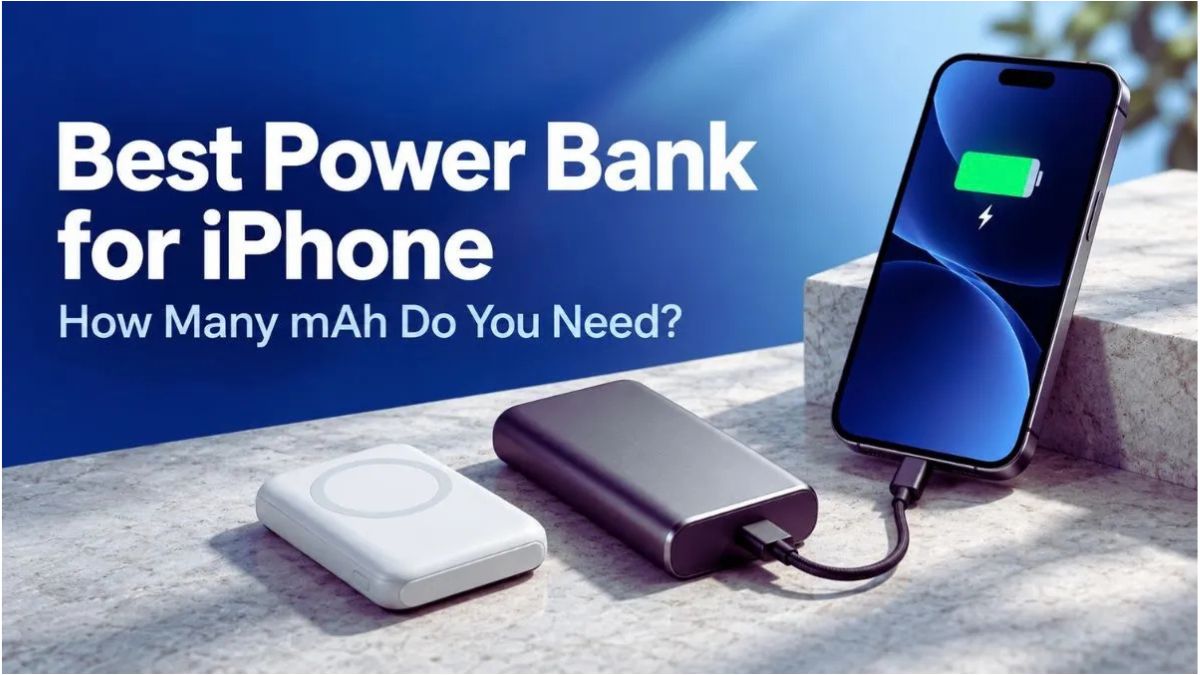
How Many mAh Do You Need to Charge an iPhone?
How much power bank capacity does your iPhone really need? Learn when to choose 5,000, 10,000, or 20,000mAh, what affects charging speed, and whether wired or magnetic charging fits your daily routine.
Which Power Bank Is Best for Your iPhone, and How Many mAh Do You Need
If your iPhone regularly runs out of battery before you get home, a portable charger can make your day easier. The difficult part is choosing one. Should you buy a small magnetic battery, a 10,000mAh USB-C model, or a larger power bank for travel?
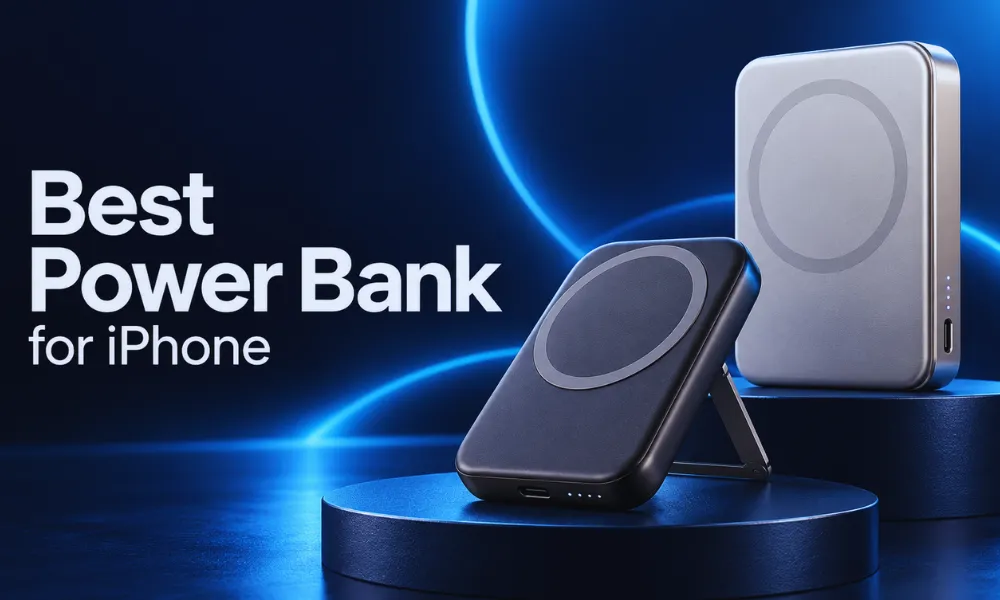
For most people, a 10,000mAh power bank with USB-C Power Delivery offers a practical balance of capacity, charging speed, and portability. A 5,000mAh model works well for occasional top-ups, while 20,000mAh makes more sense for extended trips or charging multiple devices.
However, capacity is only part of the decision. Your iPhone model, charging cable, and preference for wired or wireless charging all matter.
Here is how to choose the best power bank for your iPhone without paying for features you rarely use.
Which Power Bank Is Best for Your iPhone?
Start with a simple question: how long do you usually spend away from an outlet?
If you only need enough battery to finish your commute, a compact charger may be sufficient. If you spend the entire day taking photos, using navigation, or working from your phone, additional capacity becomes more valuable.
| How you plan to use it | Suggested capacity | Main buying priority |
|---|---|---|
| Occasional emergency charging | 5,000mAh | Small size and low weight |
| Commuting, school, or work | 10,000mAh | USB-C PD and easy portability |
| Magnetic charging on the go | 5,000–10,000mAh | Confirmed wireless compatibility |
| Longer trips with limited outlets | 20,000mAh | Capacity and fast recharging |
| Charging two phones or accessories | 20,000mAh | Multiple ports and shared output |
These recommendations are starting points. Your actual charging needs depend on how heavily you use your phone.
Before choosing the largest model, consider whether you will carry it consistently. A smaller power bank in your bag is more useful than a bigger one sitting at home.
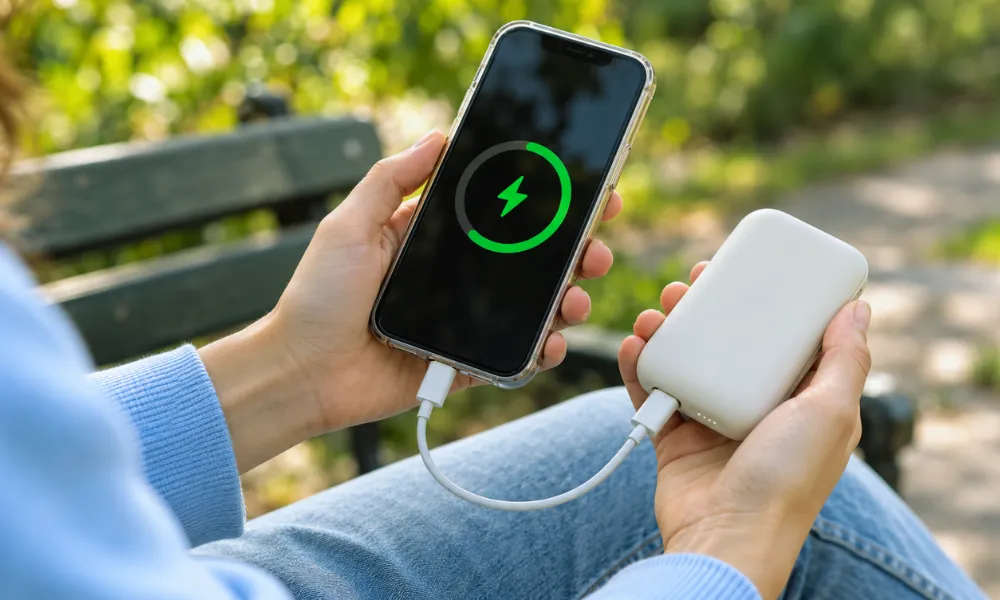
What Does mAh Mean?
The abbreviation mAh stands for milliamp-hours. It describes battery charge capacity.
When comparing power banks with similar internal battery voltages, a higher mAh rating generally means more stored energy. That extra energy can support longer use or additional charging sessions.
But mAh does not tell you how quickly a power bank charges your iPhone.
Three specifications are worth understanding:
- mAh: Battery charge capacity.
- Wh, or watt-hours: Stored energy, accounting for voltage.
- W, or watts: Charging power.
A 20,000mAh power bank with a slow output may charge your phone more slowly than a 10,000mAh model with a suitable fast-charging connection.
For a useful comparison, look at capacity and charging output together.
How Many mAh Do You Need for an iPhone?
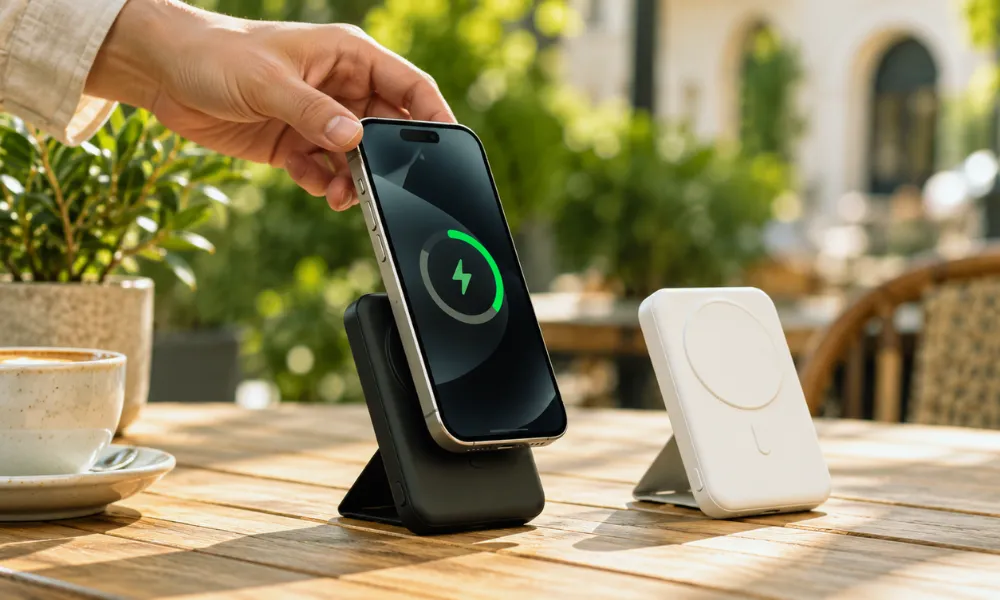
5,000mAh: For Lightweight Backup Power
A 5,000mAh power bank suits people who usually have access to an outlet but occasionally need extra battery.
It can be useful during an evening out, a short train ride, or an event where you need your phone for tickets, photos, and transportation.
The main advantage is portability. Smaller batteries are usually easier to slip into a pocket or compact bag.
However, do not assume every 5,000mAh charger will refill every iPhone from empty to full. Larger batteries, wireless charging losses, and using your phone during charging can reduce the amount added.
Choose this capacity when your goal is to get through the rest of the day.
10,000mAh: For Everyday Charging
A 10,000mAh power bank is a sensible choice if you regularly spend a full day away from home.
It offers more backup than a small emergency charger while remaining manageable for daily use. This capacity suits commuters, college students, travelers, and anyone who relies heavily on navigation or mobile data.
It also provides flexibility. You might use it for a substantial phone recharge one day and several smaller top-ups another day.
If you are buying your first portable charger and have no unusual requirements, start by comparing models in this range.
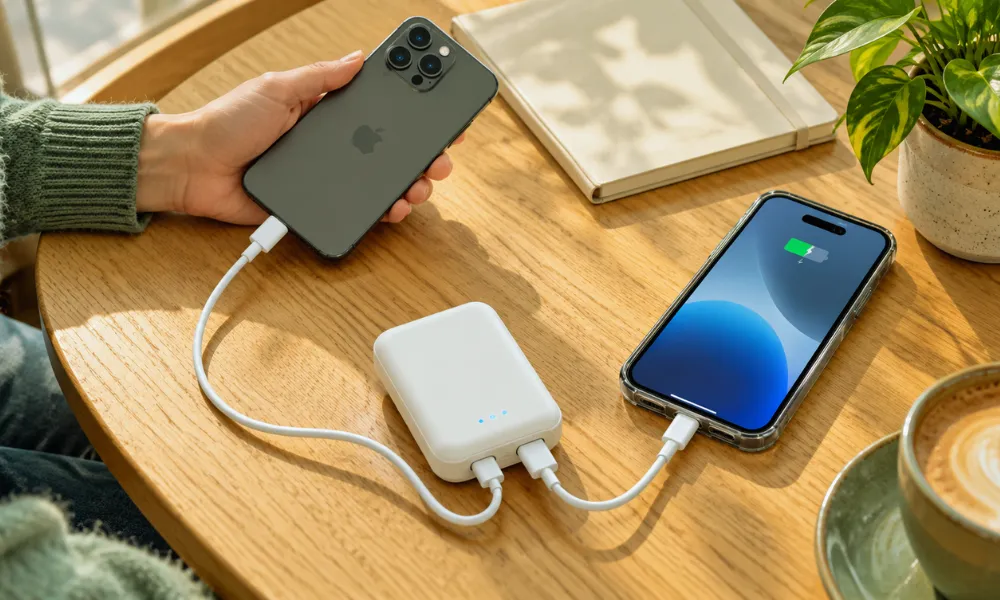
20,000mAh: For Travel and Multiple Devices
A 20,000mAh power bank is worth considering for camping, long road trips, or weekends with limited access to outlets.
It can also be useful when you need to charge your iPhone alongside another phone or accessories.
The main compromise is bulk. A larger battery adds weight to your bag and may take considerably longer to recharge if its input power is low.
For everyday emergency use, this capacity may be more than you need. For longer periods without reliable charging, the extra reserve can be worthwhile.
Why Advertised Capacity Does Not Equal Delivered Charge
A power bank labeled 10,000mAh does not transfer that exact amount of charge into your iPhone.
Its advertised capacity usually describes the internal battery cells. Those cells operate at a different voltage from the charging output, and the electronics consume some energy during conversion.
Anker illustrates this with a 10,000mAh battery rated at 3.7 volts. It stores approximately 37Wh, equivalent to 7,400mAh at a 5-volt output before circuit losses. The smaller output figure partly reflects the different measurement voltage, rather than simply missing energy.
Additional energy is lost during charging, and your phone may continue consuming power throughout the session.
This is why dividing a power bank’s advertised mAh by your phone’s battery mAh can overestimate the number of full charges.
How Many Times Can a Power Bank Charge an iPhone?
The answer depends on the phone’s battery energy, the power bank’s efficiency, and the charging method.
For a clearer estimate, use watt-hours:
Estimated full charges = energy reaching the phone battery ÷ phone battery energy
The following example assumes a phone battery of 15Wh and that 75% of the power bank’s stored energy reaches that battery through wired charging.
| Power bank capacity at 3.7V | Stored energy | Calculated full charges |
|---|---|---|
| 5,000mAh | 18.5Wh | About 0.9 |
| 10,000mAh | 37Wh | About 1.9 |
| 20,000mAh | 74Wh | About 3.7 |
These are illustrative calculations using assumed values, rather than measured performance for a specific iPhone or power bank.
A phone with a smaller battery could receive more charges. Wireless charging or heavy phone use during charging could reduce the total.
Also check how manufacturers describe their results. Charging from 50% to 100% is a top-up, not a full recharge from empty.
What Charging Speed Should You Choose?
For everyday charging, 20W to 30W USB-C Power Delivery is a useful starting point for many iPhones. However, it will not necessarily deliver the fastest charging available on every newer model.
Apple’s requirements vary by phone. Its current guidance specifies higher-power charging equipment for some recent models, including additional charging-protocol requirements for iPhone 18 Pro models. If maximum speed is your priority, check your exact iPhone’s requirements and the power bank’s supported output profiles. Apple Support
Do not judge speed by the largest number on the packaging alone. A “65W” power bank may only provide that output through one port, and connecting another device can change the available power.
Your phone controls how much power it accepts. Charging speed also changes with battery level, temperature, and usage.
Wired or Magnetic Wireless: Which Is Better?
Wired Charging Offers Practical Flexibility
A wired power bank is a good choice when charging efficiency and versatility matter.
You can keep the battery in your bag while using your phone, replace the cable when needed, and use compatible connections for other devices.
Apple specifies USB-C cables for iPhone 15 and later and USB-C-to-Lightning cables for earlier Lightning-equipped models when using compatible fast-charging equipment. Apple Support
A built-in cable is convenient if you frequently forget yours. A detachable cable is easier to replace and can offer more flexibility when charging different devices.
Magnetic Charging Simplifies Quick Top-Ups
A magnetic power bank attaches to the back of a compatible phone, letting you charge without connecting a cable.
That convenience can be useful while walking, taking calls, or using your phone at an event. However, the battery adds thickness and weight directly to the phone.
Check the wireless charging standard carefully. “Magnetic” or “MagSafe-compatible” wording alone does not guarantee a particular charging speed.
For example, Belkin sells magnetic models rated for 7.5W and Qi2-certified models rated for 15W. The exact product and your iPhone’s compatibility determine the available performance.
A magnetic case may help a battery attach, but it does not change the phone’s underlying charging capabilities.
iPhone Power Banks Worth Comparing
These options are selected by their published features. They should be compared against your needs rather than treated as a hands-on test ranking.
Anker Nano Power Bank: For Everyday Wired Charging
The Anker Nano Power Bank with built-in USB-C cable offers 10,000mAh capacity and up to 30W single-port output. Its specifications also list up to 30W USB-C input for recharging the power bank.
This combination makes it worth considering for USB-C iPhone users who want a portable battery with an attached cable.
Check its size, current price, and output when charging multiple devices before purchasing.
Anker Zolo 10K 30W: An Alternative to Compare
The Anker Zolo 10K 30W includes a built-in USB-C cable and 10,000mAh capacity, according to its US product listing.
Compare it with similar models based on dimensions, input speed, port arrangement, and warranty. Two batteries with the same capacity can feel quite different in daily use.
Belkin BoostCharge Pro Qi2: For Magnetic Convenience
Belkin’s BoostCharge Pro Qi2 15W range includes 5,000mAh and 10,000mAh options with a kickstand.
The smaller capacity is worth considering for occasional top-ups. The larger version offers more stored energy for longer days.
Check wireless compatibility and wired output separately, especially if you plan to switch between cable and wireless charging.
Features That Matter Beyond Capacity
Fast input charging: Output charges your phone; input recharges the power bank. Both matter, particularly when you have limited time between trips.
Shared power: Multiple ports do not guarantee full-speed charging on every connection. Read the combined-output specifications.
Size and weight: Product photos can hide bulk. Check actual measurements, especially for batteries you plan to carry in a pocket.
Battery indicator: A percentage display helps you judge when to recharge, although it is still an estimate.
Seller and warranty: Look for clear product identification, return policies, and support. Check the exact model against manufacturer recall notices.
Cable arrangement: Consider whether an attached cable reaches comfortably and whether a separate port remains available if you need another connection.
Can You Take a Power Bank on a US Flight?
Power banks must travel in carry-on baggage, not checked luggage. If your carry-on is checked at the gate, remove the power bank and keep it in the cabin.
The FAA generally allows lithium-ion batteries rated up to 100Wh, with airline approval required for certain larger batteries. Airlines can impose stricter limits, so confirm your carrier’s rules before traveling.
A 20,000mAh battery rated at 3.7 volts equals approximately 74Wh. Use the actual Wh rating printed on your charger when checking its eligibility.
Protect the power bank from damage and short circuits while traveling.
Frequently Asked Questions
Is 10,000mAh Enough for an iPhone?
It is a practical capacity for most everyday needs. The number of recharges depends on your iPhone model, charging efficiency, and how much you use the phone while charging.
Is 20,000mAh Better Than 10,000mAh?
It provides more stored energy at a comparable battery voltage, but it also adds bulk. Choose it when travel or multiple devices justify the extra capacity.
Does More mAh Mean Faster Charging?
No. Charging speed depends on output power, supported protocols, the cable, and the phone. Capacity mainly affects how much backup energy is available.
Should You Buy a Magnetic Power Bank?
Choose one if cable-free charging would make your routine easier. Confirm compatibility, wireless output, and case requirements before buying.
How to Make Your Final Choice
For occasional backup, choose a compact 5,000mAh model. For commuting and full days away from an outlet, start with 10,000mAh. For longer trips or charging several devices, consider 20,000mAh.
-
RGVOTA 38800mAh Power Bank Review
- Then check the connection, charging output, input speed, and physical size.
The best power bank for your iPhone is the one that meets your actual charging needs and fits comfortably into your routine.
Best accessories:-
-
Best Budget Power Banks Under $50 in the USA (2026)
-
Best Ways to Choose a Power Bank in 2026
-
Samsung 27 Inch S3 Monitor Review: 120Hz FHD IPS Display
-
MANSPOT Groin & Body Hair Trimmer for Men Review 2026
-
Govee RGBIC LED Strip Lights for Bedroom Ceiling Under $50 (2026 Review USA)
-
Amazon Alexa Tablet 12 Pro vs 11 vs 8: Full Comparison
-
M6 Mac Mini Deal: Apple’s New Mac Mini Is Over $100 Off
-
Cillso Smart Watch with Alexa Built-in Review (2026)